NICK HEATH PREPARES TO GO REMOTE
Those of you who regularly read this magazine may have joined me vicariously in the reports and stories published in SportPilot over the years of my travels across this big, wide country. I have to admit that long-distance flying to new destinations is my favourite form of aviation. Everything else just feels like training for these trips. Being able to get in an aircraft, go to a meeting hundreds of miles away, and be back for dinner is a fantastic benefit, but I’m not sure it brings me joy. I can’t think of a single long trip I’ve done where there hasn’t been something that could’ve upset the program that was, thankfully, solved before it became a major issue because of a healthy dose of prior planning. So, for those that have asked, here’s a bit more of a breakdown of what I carry and how I prepare for long trips.
Packing the Bare Necessities
It would be lovely to be able to take everything you could ever need, but space and weight prevent that. We are flying light aircraft, after all, so that means you have to triage your carriage. In my aircraft we have 290kg of useful load. With the long-range tank fitted (7kg empty) and fuel loaded (184 litres) I theoretically have 154kg to spare – plenty you’d think for one large, fat (possibly big-boned) pilot and gear. But it isn’t quite that simple because of weights and balances. The long-range tank behind the seats robs me of half of the baggage area capacity. To overcome this, I remove the passenger seat cushions, use the seat area to carry baggage and use the passenger straps to keep the load in position. There’s also a good amount of space behind the seat backs in front of the long-range tank.
The flight bag sits beside me on the passenger seat (actually it’s on the personal bag which replaced the seat cushions) and contains everything I might need in flight plus some safety gear, including maps, a camera, logbook, windscreen cleaner and soft cloths, licence, tissue/wipes, spare radio, spare batteries, pens, kneeboard, drinks and spare water, spare reading glasses, EPIRB, snacks, lunch when required, more snacks, and the ever important wee bottle. Just remember that if you’re going to drink a couple of litres on a five-hour flight, you can expect most of that to come back out again. Just saying…
Tools & Spares
Tools are heavy, so you have to limit what you carry. I have a tool roll with the following:
- Flat/Phillips head reversible medium screwdriver
- Mallet (for tie-down pegs)*
- Pliers with a cutting section
- Medium shifting spanner
- Electrical tester
- Engine oil – 2 litres
- Box cutter
- Tube repair kit
- 12V jump battery
- Cable ties and speed tape
In motorsport they say that if you can’t fix it with cable ties and speed tape, you’re not using enough cable ties and speed tape, so I always bring plenty of both. The tool roll is great because it stops the tools rattling and rubbing against other stuff. It sits behind the passenger seat back, so I could get to it in flight if I had to.
The Camping Kit
As a young man I did a lot of hiking. We would carry our food, tent, sleeping bag and gear, and spend several days and nights hiking through the high country. That gear was bulky, heavy and expensive. Thanks to the growing popularity of the outdoors, we now have affordable, super-lightweight gear which compacts to a fraction of the size. That means you can pack a whole set of gear in the plane. The major items I carry are:
- Lightweight bivvy swag
- Lightweight -5 degree sleeping bag
- Self-inflating sleeping mat
- Dixie set knife fork and spoon
- FRED
- Mug
The bivvy bag is more like where swag meets tent. It’s a one-person, waterproof sleeping bag cover with some hoops to keep it off your face. Great for a night or two underwing. Add the sleeping mat and it’s relatively comfortable. The Dixie set and FRED is a hangover from my earlier camping and cadet days.

FRED is a Field Ration Eating Device. Only the army, huh? It’s a small, flat spoon with can opener. You could probably find something better, but I’m used to it and it all packs up into one nice, small box. Hint: throw a small washcloth in to stop it all rattling about. All of that is under three kilos and fits into a ripstop nylon bag.
Safety Gear
I guess everything on this list could be thought of as
safety gear, but there are some specific items designed
to deal with an emergency if it arises.
- EPIRB with GPS
- Spare radio and headset attachment
- SOS kit
- Aviation life jacket
- First aid kit
The EPIRB and life jacket were added to the kit when I went up to Boigu Island, just short of Papua New Guinea. I can’t see any reason not to carry them. The spare radio is an Icom ACE25 handheld. The SOS kit is a little tin like they used to sell tobacco in (for those that remember). It’s packed with goodies, from a signalling mirror to paracord and matches. It was a little thing that I bought off the web, and it has a gazillion bits and pieces in it. It even has a tiny Temu pocket multi-tool. I hope I never have to open it. Some of the safety gear sits in the flight bag and the rest goes in the back with bulky gear.
The Tie-Down Set
I’ve been to some out-there places, and I can’t emphasise properly tying down an aircraft enough – especially if you aren’t familiar with local weather. I have a bag that lives in the plane with tie down gear. Up until recently, this consisted of a set of tie-down ropes with carabiners, wheel chocks for all wheels, gust lock and pitot cover, plus short steel stakes and a mallet to bang them in with. I’m getting ready to change my methodology around the steel pegs and mallet. I’ve been using screw-in pegs for camping and marquee installs and I am suitably impressed.
The only thing is that in sandy soil you need a broader screw thread (technically I think it’s called the gauge) so that it will stick in firmly. In other areas you really need a thin strong screw. I think the solution is to carry three steel 30cm hex-headed screw-in pegs and three wider nylon sand-suitable pegs plus a ratchet spanner. That’s still a lot lighter and less bulky than steel pegs (effectively short star pickets) and a mallet. Although I will miss “Mjolnir” my favourite mallet, which was also useful for venting frustration when a peg won’t go in by throwing it as far as I could. The walk to pick up the mallet and back is quite soothing. The tie-down gear goes behind the pilot’s seat as it’s quite heavy and helps bring the weight forward if needed.
Food and Water
I’m a big fan of carrying a lot more water than I think I’ll need. I know it’s weight, but of all the things likely to kill you in a remote environment, I rate dehydration to be right up there. So, in addition to daily-use water, I will normally carry five more litres. For truly remote stuff I will up that to ten litres with a cask or similar. The water goes into two litre polycarbonate bottles. Dark colours are good and the ones with the glow in the dark tops are my favourite, though a bit pricey. When I started flying remotely, I got a few of those “survival” 24-hour ration packs and figured that would cover an emergency. They travelled with me for a while – until I tried them. As the use-by date was approaching, I thought “I’ll give these a go and order some replacements.” It didn’t go well. Let’s just leave it at that. So now I carry some normal food. For snacks I have muesli bars, trail mix and dry biscuits. Instead of the 24-hour ration (shudder) I tend to carry a couple of tubs of tuna and rice, some two minute noodles, porridge sachets, a couple of fruit tubs and some tea bags.
In a survival situation, I consider the tea bags the most important. It’s amazing what a cup of tea can do to improve your outlook. After all, it was the fuel of empires. Other than the day’s food and water, most goes over the back to the luggage area, except for half the emergency water which goes behind the passenger seat.
The Personal Bag
The last item is the personal bag, which can get quite substantial if it’s a 10-day trip. I use a combo backpack/roll on luggage because it can be quite a hike to accommodation. It carries clothes, toiletries and probably my laptop if I’m working. I try to keep all that under 10kg. You have to calculate where you might get a laundry opportunity and how many days of shirts/socks and jocks that translates to.

Flying aircraft can be a sweaty business, so it’s nice to start fresh each morning. When you are travelling the length of the country you have to pack for winter (thanks Victoria) and the tropics (potentially, also Victoria, but more likely northern states) so I have a good, light-weight rain jacket which is also high viz – good for airside and potential ‘please rescue me’ wear. For that casually stranded look; shorts and full pants, boots and open footwear, t-shirt with a jumper as backup. A fleecy zip-up jumper won’t win you many fashion shows but can be taken on and off in flight and makes a nifty blanket or pillow if required. The personal bag sits on the passenger seat, with the flight bag on top, all strapped in.
Loading
Before loading, I do weights and balances. I prefer not to travel right at the edge of MTOW. Sometimes airfields are hot, high or short. After a final triage, we’re ready to stow. If you like Tetris and aerobics, you will love this bit. When it’s all stacked beside the plane, I always wonder how this is going to ever fit, but once packed it’s all neat and tidy. The priority is to have the stuff I need during the flight at hand, the heavy stuff as far forward as possible and the bulky stuff behind me in the luggage area. Do empty the plane out and reload to ensure that everything is actually there. A checklist is your friend.
If packed right, the rear of the aircraft remains largely undisturbed for the flight and I only need things from the top layer of the luggage area, the passenger seat and behind the seats. As the trip progresses, things can get untidy, so a repack once or twice is a good idea.
Getting the Plane Ready
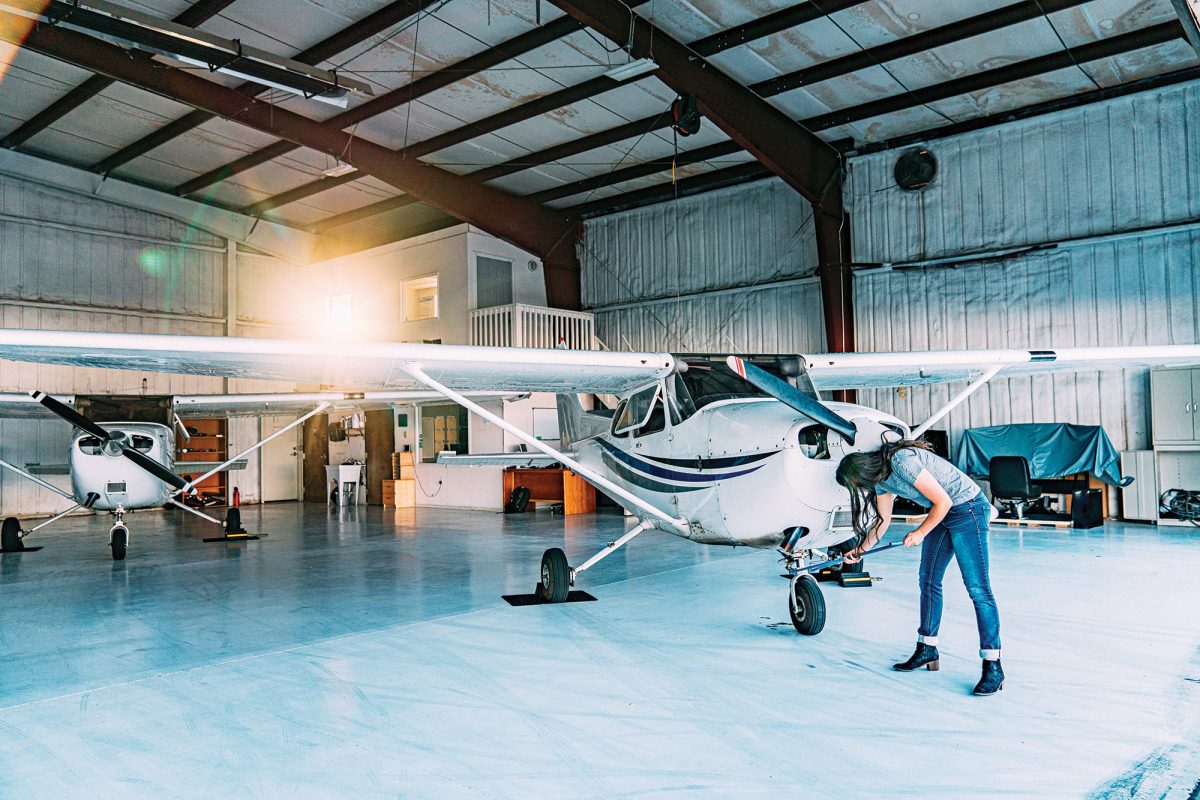
Of course, none of this matters if you don’t have the plane ready to go. I make sure that I go and do some circuits a few days before I head out, to make sure the plane is A-OK. I do an extra big preflight and I will be looking closely at the wheels and tyres, probably adjusting the air pressure (which is a pain in our aircraft because of the wheel spats) and leave the aircraft clean, topped up and good to go. The oil funnel, fuel tester and dipstick all live in the glovebox. The plane is ready and I’m also better for having reacquainted myself with the aircraft if it’s been a minute. If we are getting close to the annual, I will book it in prior to the trip, because it’s a confidence booster when you’re out there.
This isn’t an exhaustive list, just the major bits! I know I travel like the Livingstone expedition, but it has saved me and occasionally others on many occasions. Everyone has their own approach, and I’d love to hear your thoughts on what is on your “must carry” for remote flying. Email us at editor@sportpilot.net.au